10 Massages and Stretches for a Frozen Shoulder
June 15, 2023
Sunita sat in the dentist's chair, her left jaw throbbing. The pain had started three weeks ago. She thought it was just a bad tooth. After all, she was only 44. Heart attacks happen to older people, right? To men who smoked and drank. Not to vegetarian mothers who cooked healthy meals for their families.
The dentist examined her tooth. "Everything looks fine," he said. But Sunita insisted. The pain was unbearable. So he pulled the tooth.
Two days later, Sunita collapsed while making breakfast. Her daughter found her on the kitchen floor, gasping for air. The ambulance rushed her to the hospital. The diagnosis shocked everyone. She had suffered a massive heart attack. The jaw pain? It was her heart crying for help. Not her tooth at all.
Sunita survived. But she lost 40% of her heart function. "If only I had known," she tells other women now. "If only someone had told me that jaw pain could mean my heart was in danger."
This story isn't rare. Every day, Indian women miss the warning signs. They ignore symptoms. They put their families first. They think they're too young, too healthy, or too busy to have a heart problem. And by the time they realize what's happening, it's often too late.
Here's what you need to know: Heart attacks don't always announce themselves with dramatic chest pain and a sudden collapse. In fact, 8 out of 10 Indian women experience completely different symptoms. Symptoms that look like everyday problems. Symptoms that get ignored until it's too late.
The numbers tell a frightening story. India carries 60% of the world's heart disease burden, even though we're only 20% of the global population. But here's what shocks most people: women in India develop heart disease 10 years earlier than women in Western countries.
Let me share some facts that should make every woman sit up and pay attention:
You might be thinking, "But I'm not overweight. I look healthy." That's where the danger hides.
Indian women face a unique problem that doctors call the "thin-fat" syndrome. You look slim on the outside. Your weight seems normal. Your BMI might even be in the healthy range. But inside, you're carrying dangerous levels of visceral fat around your organs. Your cholesterol is high. Your blood sugar creeps up. Your arteries start blocking.
This happens because of our South Asian genetics. Our bodies store fat differently than Western bodies do. For an Indian woman, a waist measurement over 32 inches puts you in the danger zone. For other women around the world, that number is 36 inches. See the difference? The standards don't fit us. And most Indian women don't know this.
I've spoken to hundreds of women at our Cardiac hospital in Hyderabad. They all say the same things:
Cultural expectations play a huge role here. Women put everyone else first. Your children's exam stress feels more important than your jaw pain. Your husband's dinner deadline feels more urgent than your breathlessness. Your mother-in-law's needs come before your own chest discomfort.
Plus, there's another problem. When women do seek help, doctors often misdiagnose them. Your fatigue gets blamed on anemia. Your chest discomfort gets called anxiety. Your breathlessness gets dismissed as being out of shape. Studies show that women wait longer for treatment. They get fewer diagnostic tests. They receive less aggressive treatment.
Here's what most people picture when they think of a heart attack: a man clutching his chest, face twisted in pain, falling to the ground. That's what we see in movies. That's what we read about. That's what we expect.
But real life doesn't work that way. Especially for women.
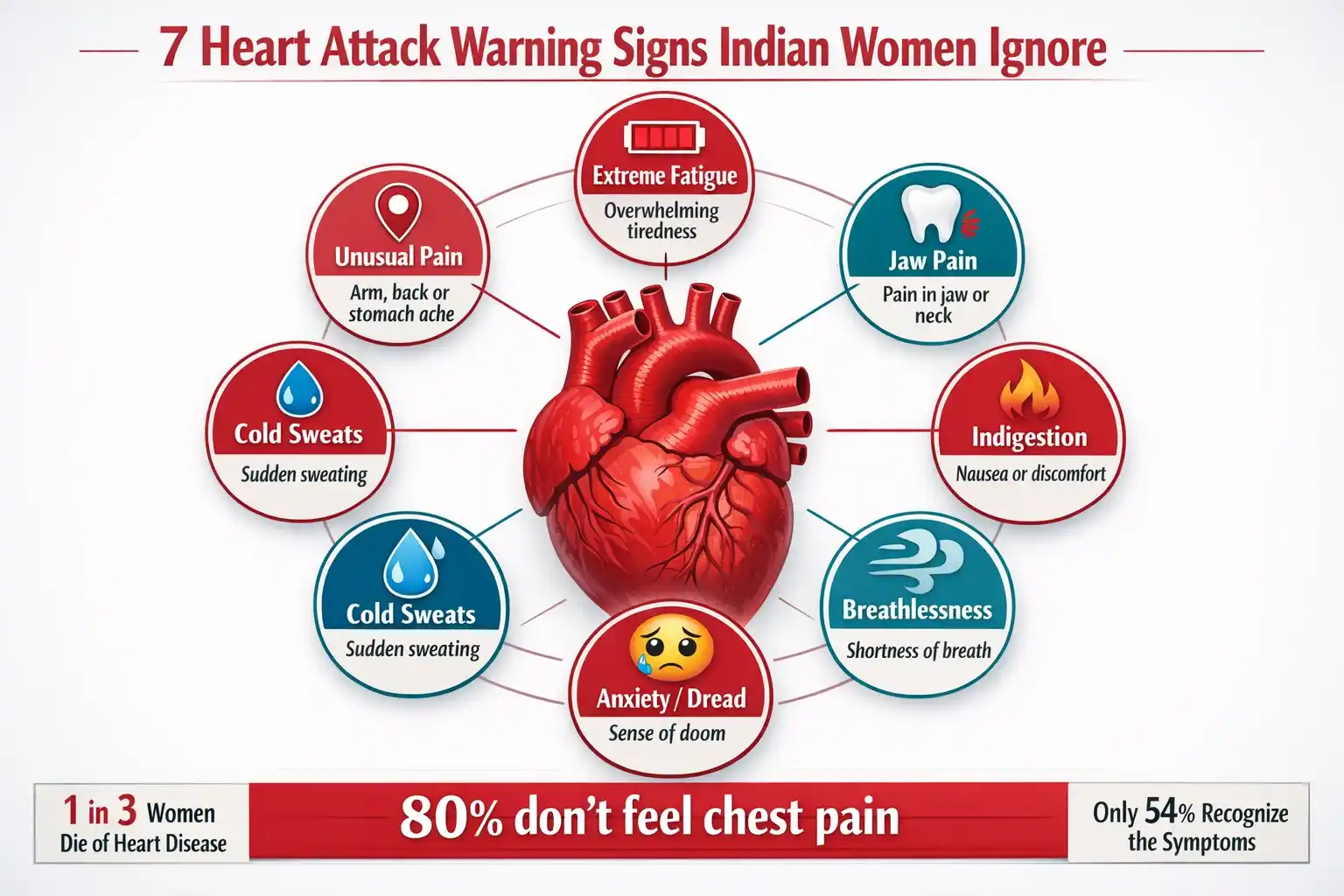
Research shows that 80% of Indian women don't experience the classic chest pain during a heart attack. Their symptoms are subtle. Confusing. Easy to miss. And this difference kills them.
Why does this happen? Women's heart disease often affects the small blood vessels in the heart. Doctors call this microvascular disease. These tiny vessels don't show up well on standard tests like angiograms. So even when a woman goes to the hospital with symptoms, the tests might look normal. The doctor sends her home saying, "Your heart is fine." But it's not fine. The damage is happening in vessels too small to see on routine scans.
Let me walk you through the real symptoms of a heart attack in women. These are the signs that Sunita ignored. The signs that thousands of Indian women miss every single day.
This isn't the normal tiredness you feel after a long day. This is different. You wake up exhausted. You can't finish simple tasks. Climbing stairs leaves you drained. Making dinner feels like running a marathon.
One woman told me, "I felt like someone had unplugged my battery. I had no energy at all. I thought I was just overworked."
This extreme fatigue can start weeks before an actual heart attack. It happens because your heart is struggling. The blocked arteries mean less blood reaches your heart muscle. Your heart works harder just to pump blood. That effort exhausts you.
Red flag: If you suddenly can't do activities that were easy before, don't ignore it. If you need to rest after every small task, pay attention.
This is the symptom that fooled Sunita. And it fools thousands of women every year.
Up to 10% of heart attacks present as jaw or tooth pain. Let me be specific here because this detail saves lives: it's usually the lower LEFT jaw. The pain feels like a severe toothache. It might spread to your ear. It gets worse when you walk or climb stairs. It gets better when you rest.
Women visit dentists. They get teeth pulled. They take painkillers. The pain continues because it's not dental at all. It's cardiac.
This happens because of the vagus nerve. This nerve connects your heart to your jaw. When your heart is in distress, the pain signals travel along this nerve. Your brain interprets the pain as coming from your jaw or teeth.
Red flag: If your dentist can't find anything wrong, but your jaw pain worsens with physical activity and improves with rest, see a heart specialist in Hyderabad immediately.
You feel a burning sensation between your belly button and your jaw. You feel nauseous. Your stomach feels uncomfortable. You burp a lot. You think it's acidity. You blame last night's spicy biryani. You take an antacid. It doesn't help.
This is one of the most dangerous symptoms because it's so easy to dismiss. In a country where everyone experiences occasional acidity, how do you know when it's serious?
Here's how to tell the difference: Heart-related "indigestion" doesn't go away with antacids. It often comes with other symptoms like sweating, breathlessness, or fatigue. It gets worse with activity. It might wake you up at night.
Red flag: If your "acidity" is new, severe, or accompanied by other symptoms on this list, don't assume it's your dinner. Get checked.
You're sitting on the couch, and suddenly you can't catch your breath. You lie down in bed, and you feel like you're suffocating. You need to prop yourself up with three pillows just to breathe comfortably. You used to climb two flights of stairs easily. Now you're gasping after five steps.
This symptom often appears before chest pain. Sometimes it's the only symptom. It happens because your heart isn't pumping efficiently. Fluid builds up in your lungs. You literally can't breathe.
Many women tell me, "I thought I was just out of shape. I thought I needed to exercise more." The irony? Exercise made it worse because their hearts couldn't handle the extra demand.
Red flag: If you suddenly can't breathe while doing activities that never bothered you before, or if you can't lie flat without feeling breathless, seek help immediately.
This symptom surprises people. How can anxiety be a heart attack sign?
But woman after woman describes it the same way: "I felt like something terrible was about to happen." "I had this doom-like feeling." "I knew something was very wrong."
This isn't regular worry. It's an intense, overwhelming sensation that grips you. Your heart races. Your palms sweat. You feel panic rising. And here's the tragedy: many women go to the doctor with these symptoms and get diagnosed with an anxiety disorder. They're sent home with anti-anxiety medication when what they actually need is cardiac care.
This happens because your body knows something is wrong. Your sympathetic nervous system goes into overdrive. It's trying to warn you. Listen to it.
Red flag: If you suddenly feel overwhelming dread or panic, especially combined with other symptoms on this list, don't let anyone dismiss it as "just stress." Insist on cardiac evaluation.
You're sitting quietly, and suddenly you're drenched in cold sweat. You're not hot. You're not exercising. You're not nervous about anything. But sweat pours down your face, your neck, your back. Your skin feels cold and clammy.
This happens because your sympathetic nervous system activates during a heart attack. Your body releases stress hormones. These hormones make you sweat. The sweat feels cold because your blood flow is compromised.
Women often tell me, "I thought I was having hot flashes." Or "I blamed it on the Hyderabad heat." But this sweat is different. It comes on suddenly. It's accompanied by a feeling of being unwell. Your skin might look pale or gray.
Red flag: Cold sweats combined with any other symptom on this list warrant immediate medical attention.
Heart attack pain doesn't always stay in your chest. In women, it travels. It radiates. It shows up in strange places.
You might feel:
I've seen women who thought they had food poisoning. Others thought they pulled a muscle in their back. Some thought they were coming down with the flu. All of them were actually having heart attacks.
The pain radiates because your heart shares nerve pathways with other parts of your body. When your heart is in distress, the pain signals get mixed up. Your brain interprets them as coming from your back, neck, or arms.
Red flag: If you have pain in any of these areas along with fatigue, breathlessness, or that feeling of doom, don't wait to see if it passes. Get help.
Call emergency services immediately if you experience:
Critical point: Do not drive yourself to the hospital. Do not wait to see if symptoms improve. Do not take a nap hoping you'll feel better. Every minute counts. Heart muscle dies without blood flow. The faster you get treatment, the more heart muscle you save.
If you need cardio pulmonary resuscitation, trained professionals can provide it. But prevention is always better. Know the signs. Act fast.
Certain factors make Indian women especially vulnerable:
After menopause: Before menopause, estrogen protects your heart. After menopause, that protection disappears. Your cholesterol rises. Your blood pressure increases. Your risk jumps dramatically.
You have diabetes: Diabetes damages blood vessels. It also masks heart attack pain. If you're diabetic and over 40, you need regular cardiac screening even without symptoms.
You had complications during pregnancy: Gestational diabetes, preeclampsia, or high blood pressure during pregnancy increases your lifetime heart disease risk.
You have a family history: If your mother or sister had a heart attack before 65, your risk doubles.
You're chronically stressed: Constant stress releases hormones that damage your heart over time.
You have depression: Depression increases heart attack risk by 64%. The connection between mental health and heart health is real.
Don't wait for symptoms to appear. Here's your action plan:
Know your numbers:
Get screened if you're:
A simple ECG, stress test, or echocardiogram can reveal problems before they cause a heart attack. At Germanten Hospital, we offer comprehensive cardiac screening packages designed specifically for women's unique needs.
Make lifestyle changes today:
I know what you're thinking. "I don't have time for this. My family needs me. I can't be sick."
But here's the truth: Your family needs you alive. Not struggling. Not disabled. Not gone.
Heart disease is the number one killer of Indian women. But it's also largely preventable. The warning signs are there. Your body sends signals. The question is: will you listen?
Sunita wishes she had. She wishes she had known that jaw pain could mean heart trouble. She wishes she had acted sooner. She's sharing her story now so other women don't make the same mistake.
You have the knowledge now. You know the signs. You know the risks. You know what to do.
The next step is yours.
If you're experiencing any symptoms or have risk factors, don't delay. Our team at Germanten Hospital specializes in comprehensive cardiac care with advanced diagnostic facilities. As one of the leading heart hospitals in Hyderabad, we understand the unique challenges Indian women face when it comes to heart health.
Remember: Early detection saves lives. A simple screening today could prevent a heart attack tomorrow.
Here's my question for you: Which symptom on this list surprised you the most? And more importantly, when will you schedule that overdue heart checkup?
Your heart has been beating for you every second of your life. Isn't it time you returned the favor?