10 Massages and Stretches for a Frozen Shoulder
June 15, 2023


Think about your morning walk. The slight groan of your knees as you stand. The sharp pinch going downstairs. You have lived with it for years, but now your doctor says it is time for a knee replacement. You feel relief, then immediate confusion. Everyone talks about "robotic surgery" as the best choice. But then you hear another term, "German Precision." Two brochures, two hospitals, both promising the latest technology. How do you choose? Is it just marketing, or is there a real, life changing difference hiding beneath the surface?
This is not a story about machines. This is a story about philosophy, tradition, and a promise for your future. Most articles will list the same benefits: accuracy, smaller cuts, faster recovery. But they miss the heart of the matter. The real difference is not in the robot's arm. It is in the mind of the surgeon using it, the depth of the plan it follows, and the legacy of excellence behind it. Let's talk about what truly matters for your knees.
When a hospital offers "standard robotic assisted knee surgery," they are talking about a powerful and valuable tool. Here is the common story:
This is true, and it represents a significant advance. For many patients, this is a great path. But calling this the "final destination" of knee replacement misses a deeper truth. It focuses on the mechanics of the cut, not the intelligence behind the entire procedure. It is like giving a master carpenter a perfectly calibrated laser guide, but not the decades of apprenticeship that teach him why one joint design will last a lifetime and another might not.
This is where the journey diverges.
This is the first thing most websites do not talk about: the core philosophy.
Standard robotic surgery often views the technology as an excellent tool. It is the latest, most precise instrument in the surgeon's tray. The training is often about operating the machine.
The German Precision approach, however, sees the technology as just one part of a complete surgical ecosystem. This ecosystem has three pillars that work together:
The question for you is this: Are you choosing a surgeon skilled with a powerful tool, or a team operating within a proven, holistic system designed for excellence?
Source: https://orthoinfo.aaos.org/en/treatment/total-knee-replacement/
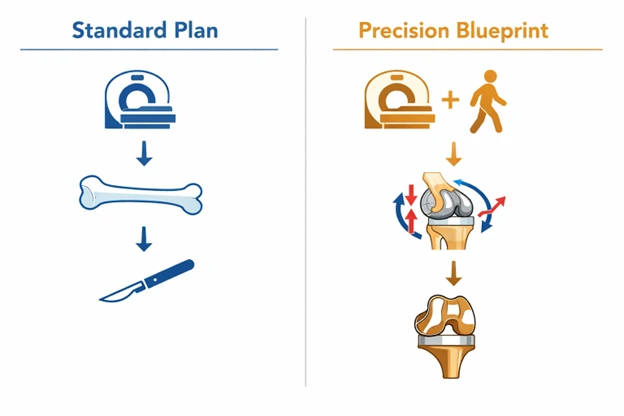
All robotic systems use pre operative planning. But here lies the second major, unspoken difference.
| Aspect of Planning | Standard Robotic Approach | German Precision Philosophy |
|---|---|---|
| Primary Focus | Bone Anatomy: Creating a precise 3D model to cut the bone to fit the implant perfectly. | Whole Joint Function: Achieving perfect ligament balance and soft tissue tension around the implant from the very first step. |
| The Plan's Nature | Static Map: It shows "where" to cut. | Dynamic Blueprint: It simulates "how" the new knee will move, bear weight, and feel after surgery. |
| Data Input | Your CT or MRI scan. | Your scan plus biomechanical algorithms plus historical data on implant performance and wear patterns. |
Here is the surprising truth most people do not realize: A knee replacement can fail long term not just because the bone cuts were wrong, but because the soft tissues around it were unbalanced. This leads to abnormal wear, instability, and a knee that just does not feel right.
German precision systems are known for their "soft tissue first" philosophy. The planning software does not just position the implant based on your bone shape. It calculates, in advance, how to position it so that all your ligaments are under ideal, natural tension. This is what leads to that elusive "forgotten joint" feeling. It is when your new knee feels so natural and stable that you stop thinking about it.
Source: https://pubmed.ncbi.nlm.nih.gov/34755615/
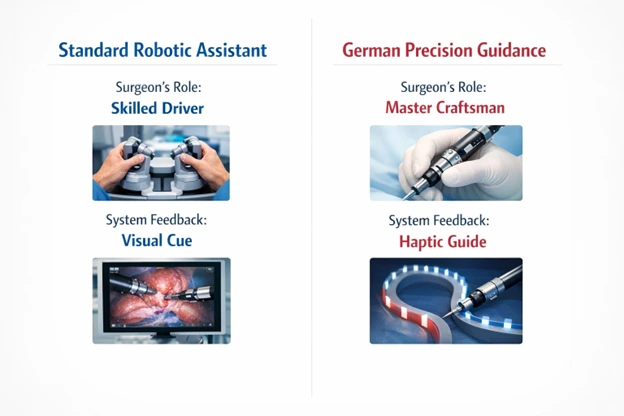
In the operating room, the difference in philosophy becomes action.
This is often achieved through advanced haptic feedback. The robotic arm does not just move freely. It can create virtual boundaries. If the surgeon's hand moves a fraction of a millimeter outside the pre-defined, optimal plan from the dynamic blueprint, the system can provide gentle resistance. It is not about taking control away. It is about ensuring the execution matches the perfect plan with absolute fidelity.
This level of integration requires more than basic training. It requires a surgeon like Dr. Mir Jawad Zar Khan at Germanten Hospitals, whose Fellowship in Arthroplasty in Germany placed him directly within this tradition. It is the difference between learning to use a software program and understanding the fundamental code it is built on.
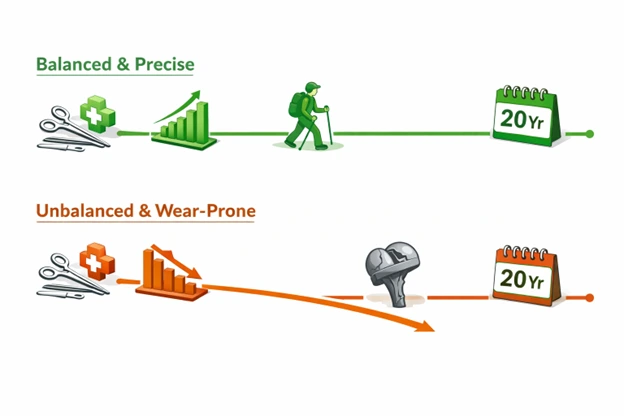
Everyone talks about short term recovery. And yes, both approaches typically offer less pain and faster mobility than old fashioned surgery. This table breaks down where the paths truly separate:
| Outcome Focus | Standard Robotic Emphasis | German Precision Goal |
|---|---|---|
| Short Term (0-12 Months) | Reduced pain, faster hospital discharge, quick return to walking. | All of the above, plus establishing a perfectly balanced, natural feeling gait from day one. |
| Long Term (10-20+ Years) | General promise of implant longevity. | Active prevention of late term failure through perfect alignment and balance, dramatically reducing uneven implant wear. |
| The Patient Feeling | "My knee is replaced and does not hurt." | "My knee feels like my own again." The focus is on natural kinematics. This means how it feels squatting, climbing stairs, or pivoting during a game. |
What most people do not realize is this: The leading cause of a knee replacement wearing out is polyethylene wear. This plastic insert slowly erodes over time. But it erodes much faster if the knee is even slightly unbalanced. Forces that should be distributed evenly become concentrated on a tiny area.
A study in the Journal of Arthroplasty highlights that even slight misalignment can increase wear rates by over 400%. The micro millimeter accuracy and obsessive soft tissue balance of the German precision approach is, fundamentally, a direct attack on this primary cause of failure. It is not just about a successful surgery next week. It is about preserving your active life 20 years from now.
Source: https://pubmed.ncbi.nlm.nih.gov/21300407/
Now, you are equipped with knowledge most patients never get. So, when you consult with an orthopedic surgeon in Hyderabad, move beyond the basic question of "Do you use a robot?"
Here are powerful questions that get to the heart of the difference:
Your choice in a knee replacement surgeon in Hyderabad is one of the most important health decisions you will make. It will define your daily comfort and freedom for decades.
This journey began with the story of your aching knees. It does not end with a successful operation. It ends with you reclaiming your life: walking without a second thought, playing with grandchildren, traveling, or simply enjoying a pain free morning.
The "real difference" between a standard approach and German Precision is the depth of commitment to that final chapter of your story. It is the difference between fixing a problem and restoring a legacy of motion. It is the choice between advanced technology and a complete tradition of excellence designed to make your new knee feel like it was always yours.
Are you ready to look beyond the brochure and find the solution built for the rest of your life?
Discover the difference precision makes. If you are seeking a knee replacement in Hyderabad defined by meticulous planning, proven tradition, and a focus on lifelong mobility, the specialists at Germanten Hospitals are here to guide you. Start your journey with a consultation focused on your unique future