10 Massages and Stretches for a Frozen Shoulder
June 15, 2023

Arjun thought he was invincible. At 31, he worked out five days a week, ran 5K every Sunday, and never touched cigarettes. His Instagram was full of gym selfies and protein shake recipes. Everyone called him the "fitness guy" at his IT company in Hyderabad.
On a regular Wednesday morning, while typing an email to his client, Arjun felt something odd. A tight pressure spread across his chest. "Must be that spicy biryani from last night," he muttered. He popped an antacid and kept working. An hour later, the pressure turned into pain. His left arm felt heavy. Sweat dripped down his face even though the AC was on full blast.
His colleague noticed. "You look terrible, man. Should we call someone?"
Arjun waved him off. "I'm fine. Just stressed about the deadline."
He wasn't fine. Two hours later, Arjun collapsed at his desk. The diagnosis at the emergency room shocked everyone: massive heart attack. His family couldn't believe it. "But he's so young! He exercises! How is this possible?"
Arjun's story is becoming terrifyingly common in India. Every day, young people in their 20s and 30s walk into emergency rooms with chest pain. Many don't walk out the same person. Some don't walk out at all.
Heart disease in young adults is when people under 40 develop serious heart problems that were once only seen in people over 60.
This isn't just bad luck. Something has changed. And if you're reading this, you need to know what it is.
Let me hit you with some facts that will make you sit up straight.
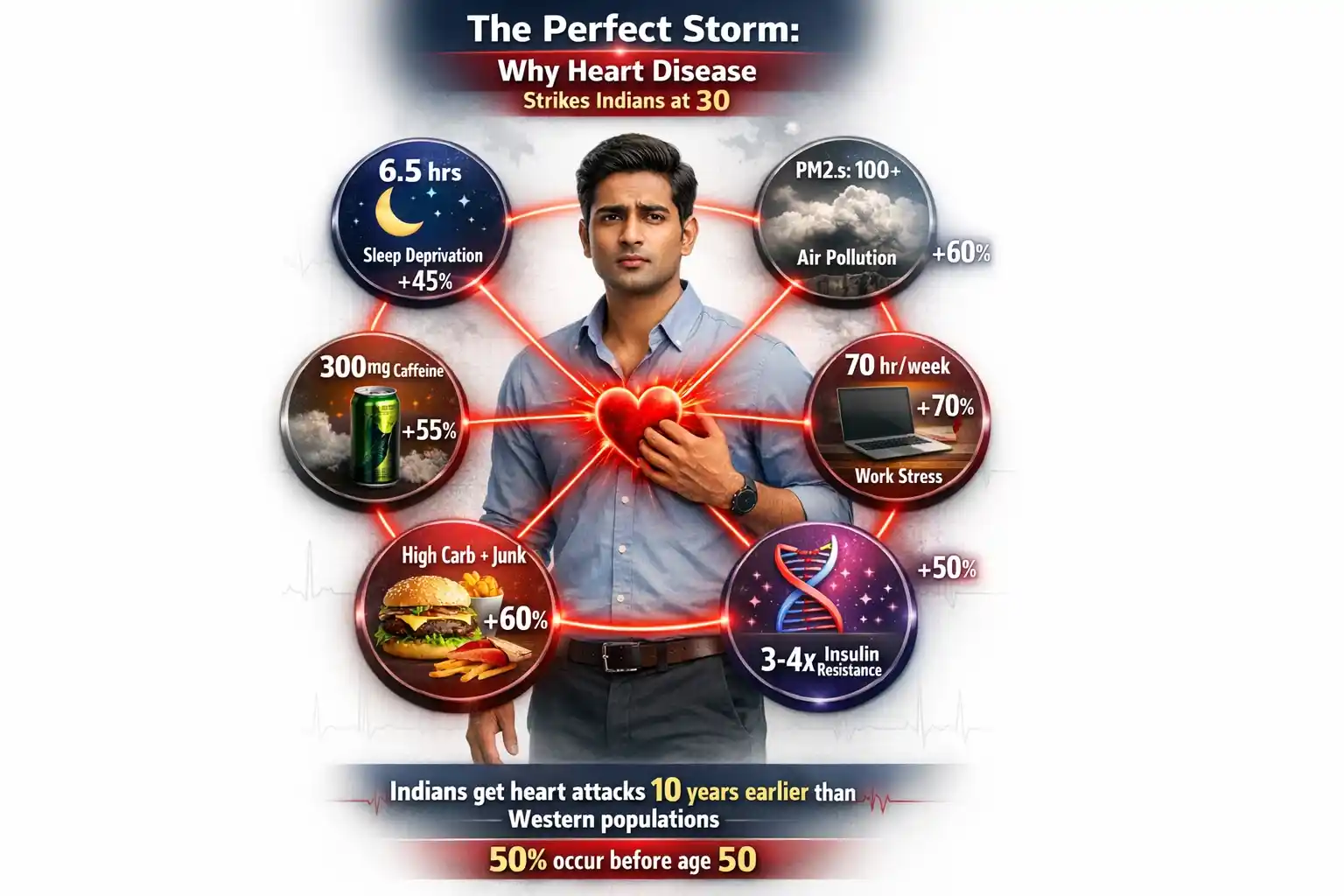
In India, 50% of all heart attacks happen in people under 50. Read that again. Half.
Even scarier? One in five heart attack patients is now younger than 40. We're talking about people who should be building careers, raising kids, and living their best years.
Here's the kicker: Indians get heart attacks 10 years earlier than people in Western countries. A 35-year-old Indian has the same heart risk as a 45-year-old American.
In 2022 alone, India saw 32,457 deaths from heart attacks. Among young adults aged 18 to 30, heart disease caused 2,541 deaths in just one year. These aren't old people dying of old age. These are young people dying of a disease that shouldn't touch them yet.
The best pulmonology hospitals in Hyderabad are seeing this surge firsthand. Young patients arrive confused, scared, and asking the same question: "Why me?"
Here's something most doctors won't tell you upfront. And it's something that makes Indians uniquely vulnerable.
You can look slim and still be dying inside.
I'm serious. Indians have what researchers call the "thin fat" problem. You might have a normal weight, wear medium-sized clothes, and have no visible belly. But inside? Your organs are wrapped in dangerous fat.
This is called visceral fat. It's not the fat you can pinch. It's the fat that hugs your liver, pancreas, and heart. And South Asians store more of it than any other ethnic group on Earth.
A study called MASALA tracked thousands of South Asians in America. The findings were shocking. Indians with "normal" BMI had visceral fat levels equal to obese white Americans. Let that sink in.
The BMI chart in your doctor's office? It lies to you. That chart says you're overweight at 25 BMI. But for Indians, the danger zone starts at 23 BMI. The international health organizations know this. Indian doctors know this. But somehow, nobody tells us.
Your DNA isn't helping either.
South Asians have what scientists call a "genetic disadvantage" when it comes to heart health. Here's what that means in plain English:
Your body is 3 to 4 times worse at processing insulin than other ethnicities. This means the same amount of rice that a white person eats causes more blood sugar chaos in your body.
Your body also produces more of the bad cholesterol carriers (ApoB) and fewer of the good ones (ApoA-1). It's like having more garbage trucks and fewer recycling trucks in your bloodstream.
Then there's Lipoprotein(a). This is a sticky, dangerous form of cholesterol. Indians naturally have higher levels of it. And unlike regular cholesterol, diet and exercise barely touch it. You can run marathons and eat salads. Your Lp(a) stays high because your genes say so.
Scientists think this goes back thousands of years. Our ancestors survived famines by being incredibly efficient at storing every calorie. That "thrifty gene" was a survival advantage back then. Today, with unlimited food everywhere? It's killing us.
Your genes loaded the gun. But modern life is pulling the trigger.
When did you last sleep 8 hours? Be honest.
The average Indian sleeps 6 to 6.5 hours per night. That's not enough. Not even close.
Your body needs 7 to 9 hours to repair itself. When you sleep, your heart rate drops, your blood pressure falls, and your body cleans out the trash from your arteries. Skip sleep, and none of this happens.
Chronic sleep loss does something nasty to your body. It floods your system with cortisol (the stress hormone). It keeps your nervous system in "fight or flight" mode all the time. This causes inflammation. And inflammation creates the perfect conditions for heart attacks.
People who sleep less than 6 hours have a 200% higher risk of calcium buildup in their arteries. That's triple the risk.
If you work night shifts? Your risk shoots up even more. Your body has a clock. When you mess with it, your heart pays the price.
Sleep apnea is another hidden killer. Millions of Indians have it and don't know. You stop breathing dozens of times every night. Your oxygen drops. Your heart struggles. Over years, this destroys your cardiovascular system.
Let's talk about something you can't avoid: the air.
India has 14 of the world's 20 most polluted cities. If you live in Delhi, Mumbai, Kolkata, or Hyderabad, you're breathing poison every single day.
PM2.5 particles are so tiny they slip straight into your bloodstream. Once there, they cause inflammation in your arteries. They damage the delicate lining of your blood vessels. They help cholesterol stick to your artery walls. Over time, this builds up into plaques that block blood flow.
The World Health Organization says safe PM2.5 levels are under 10 micrograms per cubic meter. Delhi regularly hits 100 to 300. That's 10 to 30 times the safe limit.
One study found that 1.27 million deaths in India are linked to air pollution. Half of those deaths are from heart disease and stroke.
Even indoors, you're not safe. Cooking with gas stoves, incense sticks, and poor ventilation fill your home with pollutants. If your mother or grandmother cooked over a wood stove, they breathed in the equivalent of smoking two packs of cigarettes a day.
Walk into any gym in Hyderabad. You'll see guys downing pre-workout powders and energy drinks like water.
These drinks aren't harmless. A single energy drink can contain 200 to 300mg of caffeine. That's like drinking three cups of strong coffee at once. Pre-workout supplements? Some pack 350mg or more.
Add that to the stress of intense exercise, and you're asking for trouble. Your heart rate spikes. Your blood pressure shoots up. Your arteries constrict. For someone with hidden heart disease, this can trigger a heart attack right there in the gym.
There's also a dangerous trend called "dry scooping." People consume pre-workout powder without water for a faster kick. This causes caffeine spikes that can literally stop your heart.
And many supplements sold in India contain unlabeled ingredients. Some have hidden steroids or stimulants banned in other countries. You think you're getting protein. You're getting poison.
Depression doesn't just hurt your mind. It attacks your heart.
Studies show that people with depression have a 50% to 100% higher risk of developing heart disease. Anxiety disorders also increase your risk significantly.
Here's why: chronic stress keeps your body in emergency mode. Your sympathetic nervous system stays activated. This raises your heart rate, increases blood pressure, and promotes inflammation. Do this for years, and your arteries pay the price.
India's work culture makes this worse. Sixty to seventy hour work weeks are considered normal in IT and corporate sectors. Bosses expect you to reply to emails at midnight. Taking time off is seen as weakness.
Add social isolation to the mix. Young professionals move to cities for work, leaving family behind. They work long hours, have few friends, and rarely connect with anyone deeply. Loneliness is as dangerous to your heart as smoking 15 cigarettes a day.
Indian food is delicious. It's also a cardiovascular time bomb when eaten the modern way.
Traditional South Asian diets are heavy on rice, refined wheat, ghee, and fried foods. These spike your blood sugar and pack on visceral fat. Then we added Western junk food on top. Pizza. Burgers. Fried chicken. Sugary sodas.
You're getting the worst of both worlds.
Late-night eating makes it worse. Your body can't process food well at night. That midnight biryani or dosa sits in your system, causing insulin spikes while you sleep.
Alcohol is another problem. Binge drinking on weekends (the "work hard, party hard" culture) causes inflammation, raises blood pressure, and damages your heart muscle.
Young people ignore symptoms. They think, "I'm too young for a heart attack."
That thinking kills.
Here are signs you should never ignore:
Chest pressure or discomfort that lasts more than a few minutes. It might feel like an elephant sitting on your chest. Or like someone is squeezing your heart. Don't assume it's gas.
Pain that spreads to your arm, jaw, neck, or back. Heart attacks don't always feel like chest pain. Sometimes the pain shows up somewhere else first.
Unexplained shortness of breath. If you're winded from walking up one flight of stairs when you used to run up five, that's a red flag.
Extreme fatigue that doesn't match your activity level. Feeling wiped out after a normal day at work could be your heart struggling to pump blood.
Palpitations that won't stop. Everyone's heart races sometimes. But if it happens frequently or lasts long, get it checked.
Dizziness or lightheadedness with chest discomfort. Your brain might not be getting enough blood.
Women often have different symptoms. They might feel nausea, extreme tiredness, or back pain instead of chest pain. Many women dismiss these as stress or flu. Don't.
The good news? Most heart disease is preventable. You're not doomed by your genes or your environment. You can fight back.
Get tested. Seriously. Stop putting it off.
If you're over 25, you need these tests:
If you have a family history of heart disease, add these:
A heart specialist in Hyderabad can help you understand what these numbers mean for you specifically.
Don't wait for symptoms. By the time you feel chest pain, the damage is already done.
Make sleep non-negotiable. Treat it like a medication.
Aim for 7 to 9 hours every night. Not on weekends. Every night.
Create a sleep schedule. Go to bed at the same time. Wake up at the same time. Even on Sundays.
Make your bedroom dark, quiet, and cool. Get blackout curtains. Use earplugs if needed. Keep your phone in another room.
If you snore loudly or feel tired despite sleeping, get tested for sleep apnea. It's common and treatable.
You can't fix Delhi's pollution. But you can control your home environment.
Get an air purifier with a HEPA filter. Run it in your bedroom at night.
Avoid going outside during high pollution hours (early morning and evening). Check the AQI before you plan outdoor exercise.
If the AQI is over 150, wear an N95 mask outdoors. Those cloth masks don't filter PM2.5.
Improve your kitchen ventilation. Always use the exhaust fan when cooking. Open windows to let fresh air circulate.
Indoor plants help a little. They won't solve the problem, but they don't hurt.
Throw away your energy drinks. All of them.
Limit caffeine to 400mg per day maximum. That's about 3 to 4 cups of coffee. If you're under 18, keep it under 100mg.
Stop using pre-workout supplements unless a doctor approves them. Most people don't need them. A banana and water work just fine.
If you need energy, fix your sleep instead of drinking stimulants.
Exercise is crucial. But more isn't always better.
Aim for 150 minutes of moderate activity per week. That's 30 minutes, five days a week. Walking counts. Swimming counts. Cycling counts.
Don't jump into extreme workouts if you've been sedentary. Build up slowly.
If you're over 35 or have risk factors, get cardiac clearance before starting intense exercise. Yes, even if you feel fine.
The weekend warrior approach (sitting all week, then doing marathon exercise on Saturday) is dangerous. Spread your activity throughout the week.
You can't follow a Western diet plan. Your body processes food differently.
Reduce refined carbs. Cut down on white rice, white bread, and maida products. Switch to brown rice, quinoa, or millets.
Increase protein. Aim for protein in every meal. Dal, eggs, chicken, fish, paneer, Greek yogurt.
Control portions. Even healthy food causes problems when you eat too much. Use smaller plates.
Cook at home more. Restaurant food is loaded with salt, sugar, and unhealthy fats.
Limit alcohol. If you drink, keep it to 1 drink per day for women, 2 for men. Weekend binge drinking is worse than daily moderate drinking.
Practice time-restricted eating. Stop eating 2 to 3 hours before bed. Give your body time to process food.
Because it does.
Find what works for you. Meditation helps some people. Exercise helps others. Talking to friends helps many.
Set boundaries at work. Don't reply to emails after 8 PM. Take your vacation days. Say no to unreasonable demands.
Get therapy if you need it. There's no shame in talking to a professional about stress, anxiety, or depression.
Build real connections. Join a sports club. Volunteer somewhere. Make friends outside of work. Loneliness kills.
Don't wait for a full-blown heart attack.
See a heart hospital in Hyderabad right away if you have:
If you have diabetes, high blood pressure, or high cholesterol, you need regular cardiology check-ups. These conditions rarely cause symptoms until serious damage is done.
Emergency signs that need cardio pulmonary resuscitation or immediate hospital care:
Call an ambulance. Don't drive yourself. Don't wait to see if it passes.
At Germanten Hospital, our cardiology team understands the unique risks facing young Indians. We offer comprehensive cardiac screenings designed for South Asian genetics. Early detection saves lives.
Heart disease at 30 isn't normal. But it's becoming our new reality in India.
Your genes loaded the dice against you. Modern life is making it worse. Poor sleep, toxic air, energy drinks, chronic stress, and bad food are combining into a perfect storm.
But you're not helpless.
Small changes compound over time. Sleep better. Move more. Eat cleaner. Manage stress. Know your numbers. Listen to your body.
The young people having heart attacks aren't unlucky. They're unprepared and uninformed. Don't be like them.
Your 30s should be your peak years. The decade where you build your career, your family, and your future. Don't let a heart attack steal that from you.
Start today. Not Monday. Not next month. Today.
What's the one change you'll make this week to protect your heart?
If you're in Hyderabad and concerned about your heart health, Germanten Hospital offers comprehensive cardiac screening packages designed specifically for young adults. Our team of experienced cardiologists uses advanced German technology to detect heart disease early, when it's still preventable. Don't wait for symptoms. Book your heart health check today.