10 Massages and Stretches for a Frozen Shoulder
June 15, 2023
If you live in Hyderabad, you already know the city moves fast. Long working hours, rich biryanis, bumper-to-bumper traffic on PVNR Expressway, and stress that never quite goes away. As a cardiologist practicing in Attapur, I see the consequences of this lifestyle every single day in my clinic. Young professionals in their 30s with blocked arteries. Middle-aged men and women with uncontrolled sugar and blood pressure. And unfortunately, many of them never had any warning signs until it was too late.
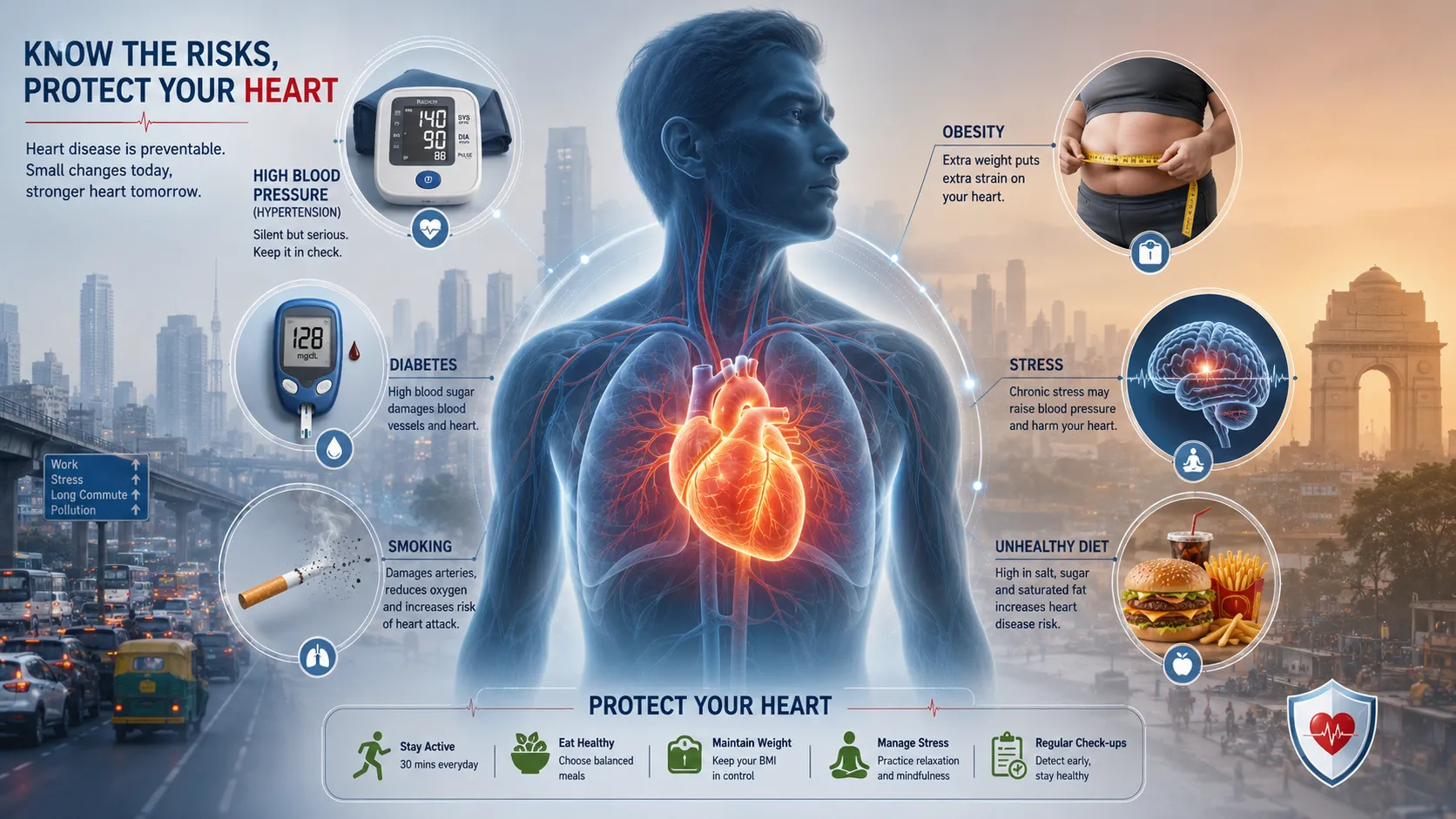
The good news? Most heart disease is preventable. Up to 80% of cardiovascular events can be avoided with the right lifestyle changes and timely medical care. So today, let us talk about the 10 heart disease risk factors that I see most commonly among people in Hyderabad, and more importantly, what you can do about each one.
Table 1: Heart Disease Risk Factor Prevalence in Hyderabad vs National Average
Sources: Indian Heart Association, ICMR-INDIAB Study, Hyderabad Urban Health Survey (2022-23)
Hypertension is probably the single most dangerous silent condition I encounter. Patients often walk in feeling perfectly fine, yet their readings show 160/100. Blood pressure this high is quietly damaging their heart, kidneys, and brain every single day. In Hyderabad, nearly 1 in 3 adults has hypertension, largely driven by our high-salt cuisine, stress, and physical inactivity.
What you can do: Reduce your salt intake. Swap pickle and papads for lemon and herbs. Walk for at least 30 minutes five days a week. If your doctor has started you on medication, please do not stop it just because you are feeling better. Hypertension needs long-term management.
Hyderabad has one of the highest diabetes rates in India. South Indians, and especially Telugus, are genetically more susceptible to insulin resistance. Add to that our love for white rice, maida-based snacks, and sugary drinks, and you have a recipe for metabolic trouble.
Diabetes does not just affect your blood sugar. It slowly damages the blood vessels that supply your heart. People with diabetes are 2 to 4 times more likely to develop heart disease compared to those without it.
What you can do: Get your fasting blood sugar and HbA1c checked every year. Reduce refined carbohydrates in your diet. Include more millets like jowar and ragi, which are locally available and excellent for blood sugar control. Exercise regularly and maintain a healthy weight.
Cholesterol problems in Hyderabad are not just about eating ghee. Many of my patients have a condition called dyslipidemia, which means their LDL (bad cholesterol) is high and HDL (good cholesterol) is low. This combination, especially with high triglycerides, is extremely common in urban populations eating processed foods and living sedentary lives.
What you can do: Get a full lipid profile done. Avoid deep-fried street food and bakery items. Eat a handful of walnuts or flaxseeds daily. Oats for breakfast three to four times a week can genuinely make a difference. If your LDL remains high despite these changes, your doctor may recommend a statin.
In Hyderabad, belly fat is almost normalized. We call it a "healthy build" in our culture. But abdominal obesity, where fat accumulates around the waist, is directly linked to heart disease, diabetes, and hypertension. A waist circumference above 90 cm in men and 80 cm in women is a red flag in South Asians, even if the overall BMI looks acceptable.
What you can do: Do not just look at the scale. Measure your waist. Focus on portion sizes and avoid late-night eating. Physical activity is non-negotiable. Even a 30-minute brisk walk after dinner can start shifting belly fat over time.
This one surprises many of my patients. They say, "Doctor, I do not do anything strenuous, so how can I have heart disease?" That is exactly the problem. Sitting for 8 to 10 hours a day at a desk in an IT park or spending evenings on the couch is one of the biggest independent risk factors for cardiovascular disease.
Hyderabad is home to one of India's largest IT workforces, and the desk-bound culture here is very real.
What you can do: Get up and walk for 5 minutes every 30 minutes. Take stairs instead of the elevator. Use lunch breaks for a short walk around your campus. Aim for at least 150 minutes of moderate-intensity physical activity per week.
Smoking is not as widespread in Hyderabad as in some other cities, but it remains a significant concern, particularly among men and in lower-income areas. What many people do not realize is that even smokeless tobacco (gutka, paan masala) raises cardiovascular risk substantially. Just one cigarette a day is enough to significantly increase your risk of a heart attack.
What you can do: There is no safe level of tobacco use. If you smoke or use any form of tobacco, quitting is the single most powerful thing you can do for your heart. Ask your doctor about nicotine replacement therapy or medications that can help.
Hyderabad is a high-achieving, high-pressure city. Deadlines, targets, traffic, family pressures, career anxiety. Chronic stress triggers the release of cortisol and adrenaline, hormones that raise blood pressure, promote inflammation, and increase the risk of abnormal heart rhythms. I have seen patients experience heart attacks triggered by major emotional events.
What you can do: Take stress seriously as a medical issue, not just a mental attitude. Yoga and pranayama are scientifically proven to lower cortisol. Set boundaries at work. Sleep adequately. Consider speaking to a mental health professional if you feel constantly overwhelmed.
Hyderabad is a food lover's city, and there is nothing wrong with enjoying our cuisine. The problem is when biryani, haleem, deep-fried snacks, and ultra-processed foods become daily staples rather than occasional treats. Our traditional diet was actually heart-healthy. It is the modern version with excess oil, salt, and refined flour that is doing the damage.
What you can do: Cook at home as much as possible. Use less oil. Choose heart-healthy cooking methods like steaming, baking, or pressure cooking. Eat more vegetables, lentils, and whole grains. Limit fast food to once a week at most.
Sleep apnea, insomnia, and poor sleep quality are increasingly common in urban Hyderabad, yet they remain dramatically underdiagnosed. Obstructive sleep apnea, in particular, causes repeated episodes of low oxygen at night, which puts enormous strain on the heart and is strongly linked to atrial fibrillation, hypertension, and sudden cardiac death.
What you can do: If your partner tells you that you snore heavily or stop breathing at night, get evaluated for sleep apnea. Aim for 7 to 8 hours of quality sleep each night. Reduce screen time before bed and keep a consistent sleep schedule.
This one is often overlooked, but it matters. Hyderabad's air quality has been worsening, especially around Attapur, Mehdipatnam, and areas near the Outer Ring Road due to construction dust and vehicular emissions. Long-term exposure to fine particulate matter (PM2.5) is associated with inflammation of the arteries and increased risk of heart attacks and strokes.
What you can do: Check the AQI before outdoor exercise. On high-pollution days, exercise indoors. Use N95 masks if commuting in heavy traffic. Keep indoor plants and use air purifiers if possible. This is especially important for those who already have existing heart conditions.
Table 2: Recommended Prevention Targets for Hyderabad Patients
Most of my patients who come in after a heart attack say the same thing: "Doctor, I had no idea." And that breaks my heart every time, because in most cases, the warning signs were there. They just were not recognized or acted upon in time.
The 10 risk factors we discussed today are not rare. They are sitting in your family, your workplace, and possibly in your own body right now. But knowing them means you have the power to do something about it.
I encourage everyone reading this to get a basic cardiovascular risk assessment done, especially if you are over 35, have a family history of heart disease, or already have diabetes or hypertension. Preventive cardiology is not about scaring you. It is about giving you the information and tools to live a longer, healthier life.
If you are in the Attapur, Tolichowki, or Mehdipatnam area of Hyderabad and would like to speak with a cardiologist, my clinic is here for you. Early screening and a few meaningful lifestyle changes can genuinely change the trajectory of your heart health.
The following sources were referenced in preparing this article:
• Indian Heart Association. (2023). Heart Disease Statistics in India. Retrieved from www.indianheartassociation.org
• Anjana, R. M., et al. (2023). Prevalence of diabetes and prediabetes in 15 states of India: results from the ICMR-INDIAB population-based cross-sectional study. The Lancet Diabetes and Endocrinology.
• Gupta, R., & Mohan, I. (2022). Trends in coronary heart disease epidemiology in India. Annals of Global Health, 82(2), 307-315.
• World Health Organization. (2023). Cardiovascular Diseases (CVDs) Fact Sheet. Geneva: WHO.
• Prabhakaran, D., et al. (2016). Cardiovascular, respiratory, and related disorders: key messages from Disease Control Priorities, 3rd edition. The Lancet.
• Hyderabad Urban Health Survey. (2022-23). Metabolic risk factor prevalence in Hyderabad districts. Government of Telangana, Health Department.
• American Heart Association. (2023). Life's Essential 8: Measuring and Boosting Cardiovascular Health. Dallas: AHA.
• Mohan, V., et al. (2020). Epidemiology of type 2 diabetes: Indian scenario. Indian Journal of Medical Research, 125(3), 217-230.
• Brook, R. D., et al. (2010). Particulate matter air pollution and cardiovascular disease: An update to the scientific statement from the American Heart Association. Circulation, 121(21), 2331-2378.
• Roth, G. A., et al. (2020). Global Burden of Cardiovascular Diseases and Risk Factors, 1990-2019. Journal of the American College of Cardiology, 76(25), 2982-3021.
• National Family Health Survey (NFHS-5). (2021). Hypertension and obesity prevalence in Telangana. Ministry of Health and Family Welfare, Government of India.