10 Massages and Stretches for a Frozen Shoulder
June 15, 2023

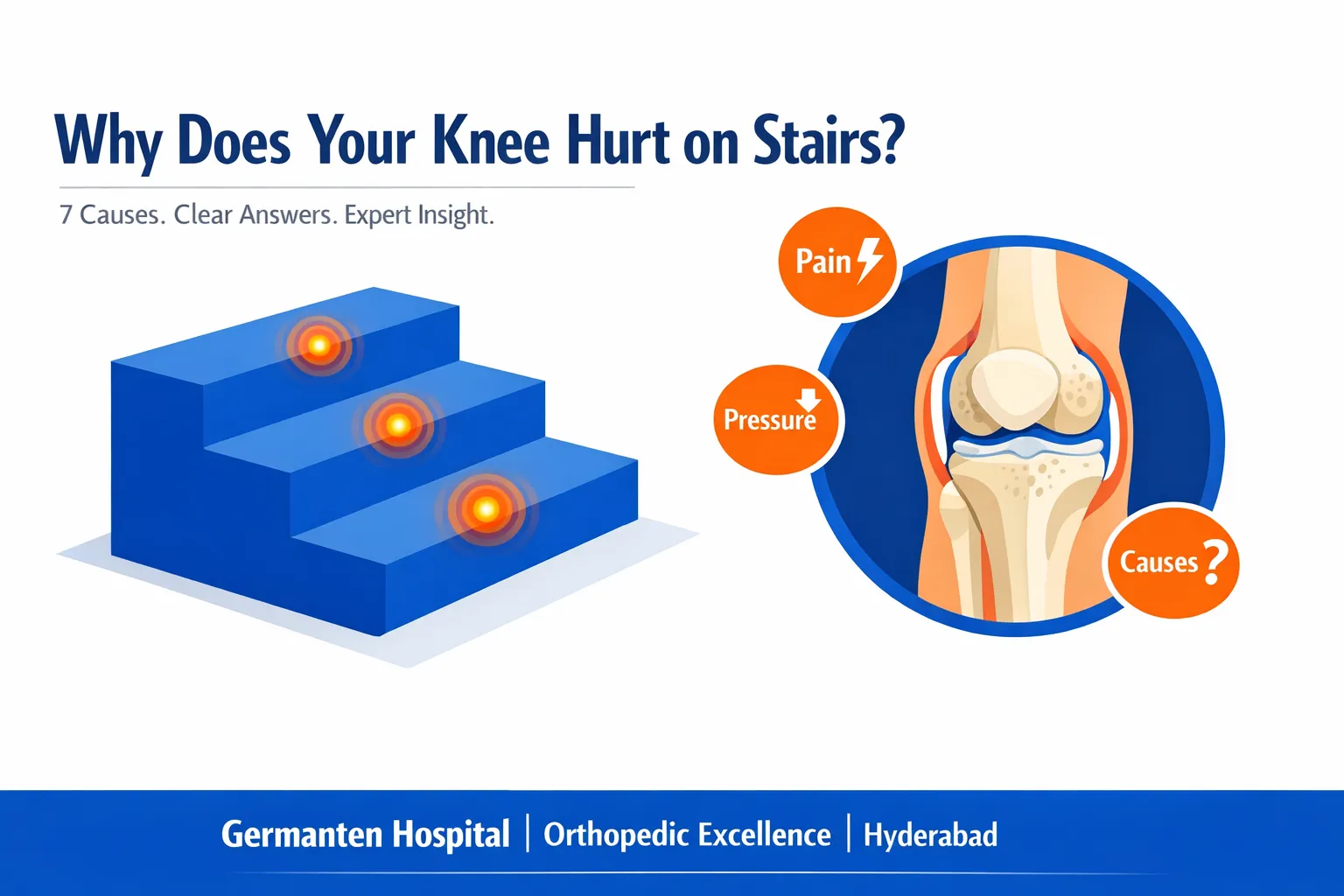
The Morning That Changed How Shubham Thought About His Knees
Shubham is 48 years old. He works as a senior manager at an IT firm in Hyderabad. He is fit enough, walks 30 minutes a day, and watches what he eats. For years, the two flights of stairs to his office felt like nothing. Then one morning, somewhere around the fifth step, he felt it. A dull, grinding ache right at the front of his knee. He slowed down, shook it off, and got to his desk. By the next week, he was timing his arrival to catch the elevator instead.
He told himself: "It's probably just age." Or maybe he had walked too much the day before. Or maybe the new shoes were the problem. For six months, Shubham kept explaining away the pain. Then, at Germanten Hospital, his orthopedic specialist looked at the MRI scan and said something that stayed with him:"The stairs didn't cause this. They just showed you what was already happening inside."
If you have ever felt that familiar twinge on the third or fourth step, this article is for you. Knee pain while climbing stairs is one of the most commonly ignored early warning signals in India. According to a 2024 study published in PMC, over 34.6% of adults above the age of 40 in South India already have knee osteoarthritis, and the activity that shows up pain most consistently is stair climbing. And yet, as pain prevalence research across eight Indian cities shows, 25.5% of people with chronic knee pain simply accept it as part of life without seeking care. That is a choice that has real consequences.
What is knee pain on stairs?Knee pain during stair climbing is discomfort or aching that occurs specifically when you bend your knee under body weight while going up or down steps. It may be felt in the front, side, or inside of the knee and often signals an underlying structural or muscular issue.
Most people assume that if they can walk fine on a flat road, their knees must be okay. That logic makes sense on the surface, but it is not how knee mechanics work. Stairs are a stress test, and your knee is the one being tested.
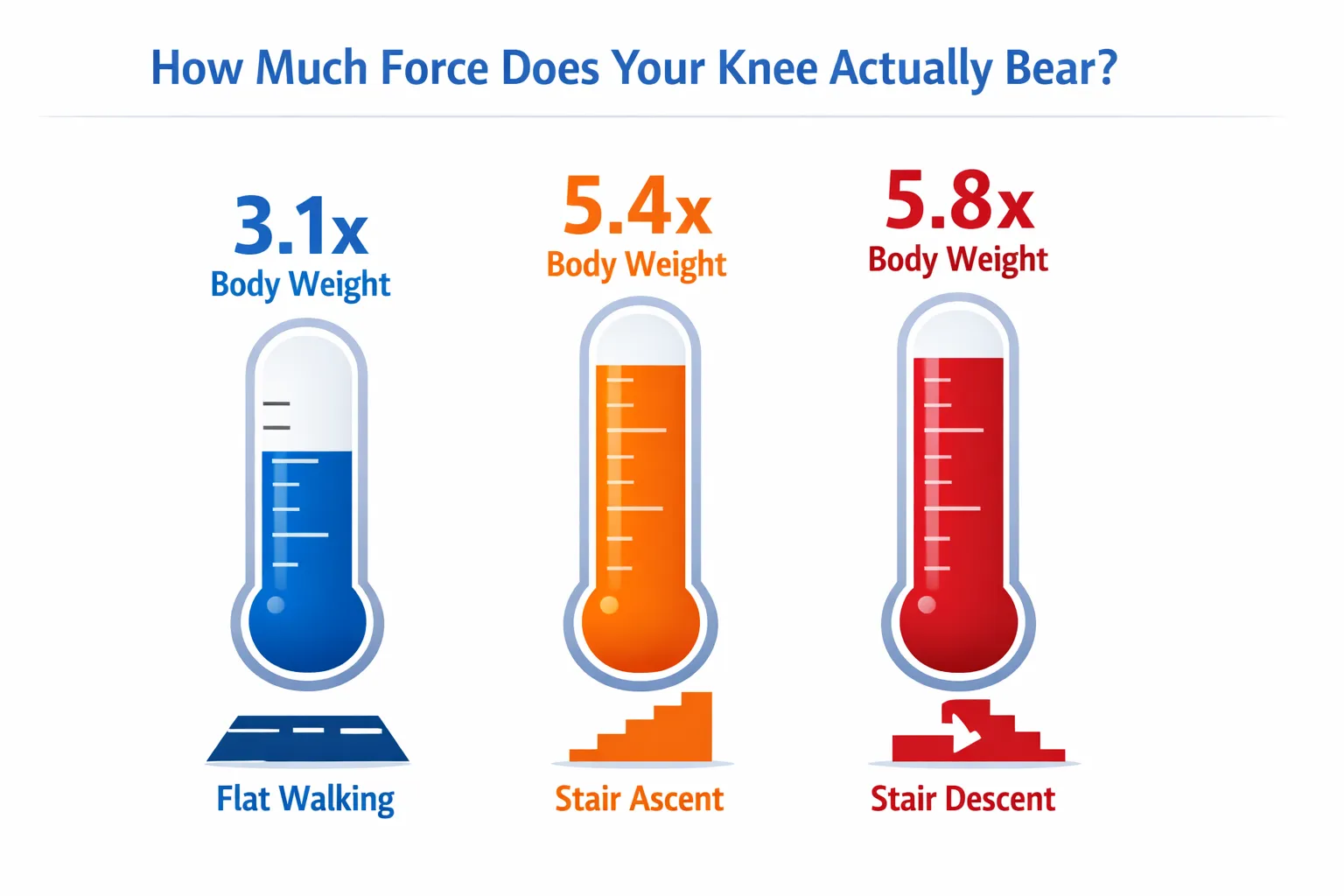
When you walk on flat ground, the force on your knee joint reaches about 3.1 times your body weight. The moment you start climbing stairs, that force jumps to an average of 5.4 times your body weight, according to biomechanical research published in PubMed. That means a person weighing 70 kg is loading their knee joint with roughly 378 kg of force on every single step up.
This extra load amplifies whatever is already wrong inside the joint. A small cartilage issue that causes no pain while walking becomes very noticeable under that level of force. The stairs did not create the problem. They revealed it.
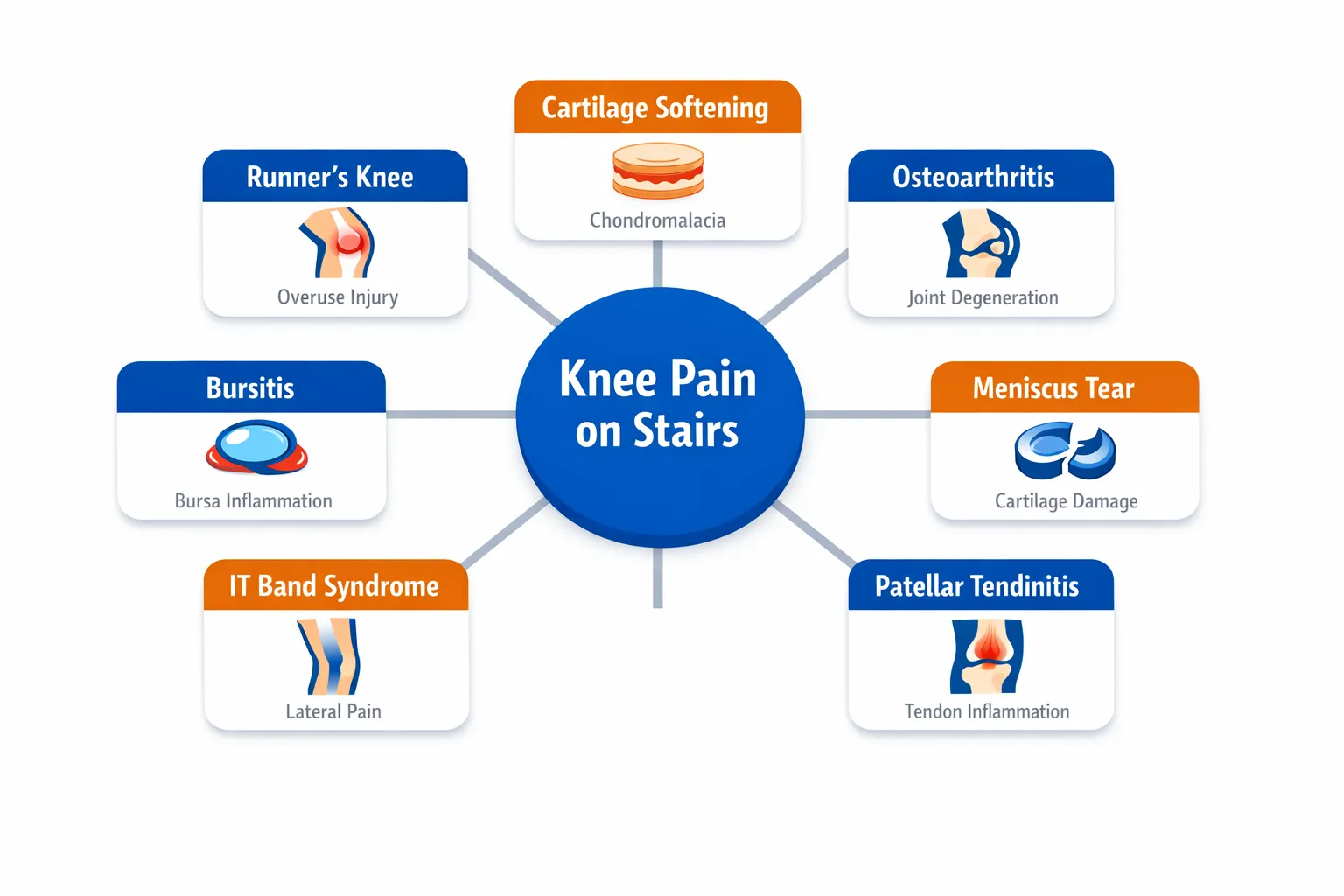
This is the most common cause of front-knee pain on stairs. The kneecap (patella) sits in a groove on the thigh bone and is supposed to glide smoothly when you bend your knee. When it tracks incorrectly, the cartilage underneath gets irritated. Stair climbing forces deep knee bending under full load, making this condition very noticeable.
Who is most at risk:Women are 2.23 times more likely to develop this condition than men, according to research on patellofemoral pain prevalence. It also affects desk workers who sit for long hours with bent knees, runners, and anyone who recently increased their physical activity.
How it feels on stairs:Dull ache or sharp pain at the front of the knee when going up. Pain may also occur after sitting for a long time with the knee bent. You might notice a grinding sensation.
Think of the cartilage under your kneecap as a cushion. Over time, or due to misalignment, this cushion softens and starts to break down. When it does, there is less protection between bone and bone. Stair climbing compresses this joint surface more than any other daily activity.
This condition is often mistaken for "normal aging." It is not. Research from ScienceDirect found that chondromalacia accounts for 75% of knee pain in active people. It is especially common in adolescents during growth spurts, young athletes, and women.
How it feels on stairs:A dull ache when climbing up, sometimes with a crunching or grinding feeling. Pain may ease during movement but return after rest.
Osteoarthritis occurs when the smooth cartilage that cushions the knee joint gradually wears away. Bone begins to rub against bone. Stair climbing forces a deeper bend in the knee, bringing more worn joint surfaces into contact, which is why stairs often become painful before flat walking does.
In India, the numbers are significant. A community-based study across five major Indian cities found an overall knee OA prevalence of 28.7%, rising to 31.6% among women. Sedentary work was a key associated factor. In Hyderabad and other urban centers, long hours of sitting followed by bursts of activity put the knee under uneven stress.
How it feels on stairs:Stiffness especially in the morning, pain that worsens with activity, occasional swelling, and a grating feeling when bending the knee.
Each knee has two C-shaped pieces of cartilage called menisci. They act as shock absorbers between your thigh bone and shin bone. When a meniscus is torn, either from a sudden twist or from gradual degeneration, the knee loses some of its ability to distribute weight evenly. Stair climbing creates both compression and a slight rotational force, which is exactly the kind of movement that stresses a torn meniscus.
How it feels on stairs:Pain on the inner or outer side of the knee (not just the front). You may feel a catching or locking sensation, as if something is getting stuck inside the joint.
The patellar tendon connects your kneecap to your shin bone and plays a major role in powering the upward push of stair climbing. When this tendon becomes inflamed or partially degenerated, that push becomes painful. It is called jumper's knee because it is common in basketball and volleyball players, but it also affects people who suddenly begin walking more, start a new exercise program, or carry excess body weight.
How it feels on stairs:Sharp pain directly below the kneecap, particularly when pushing off on the step. Worse with going up than going down.
The iliotibial (IT) band is a thick strip of connective tissue that runs along the outside of your thigh from the hip to just below the knee. When it becomes tight or inflamed, it rubs against the outer part of the knee during bending movements. Stair descent in particular can be very irritating to the IT band because of the controlled bending it requires.
How it feels on stairs:Pain on the outer side of the knee, typically more noticeable going down. It may feel like a sharp burning sensation that improves with rest.
Small fluid-filled sacs called bursae cushion the bones, tendons, and muscles around your knee. When they become inflamed from repeated pressure, kneeling, or overuse, the knee can become swollen, warm, and tender to touch. Going up stairs puts direct pressure on the front of the knee, aggravating inflamed bursae.
How it feels on stairs:Visible swelling at the front of the knee, warmth to the touch, and generalized aching. More common in people who kneel frequently, including domestic workers and tradespeople.
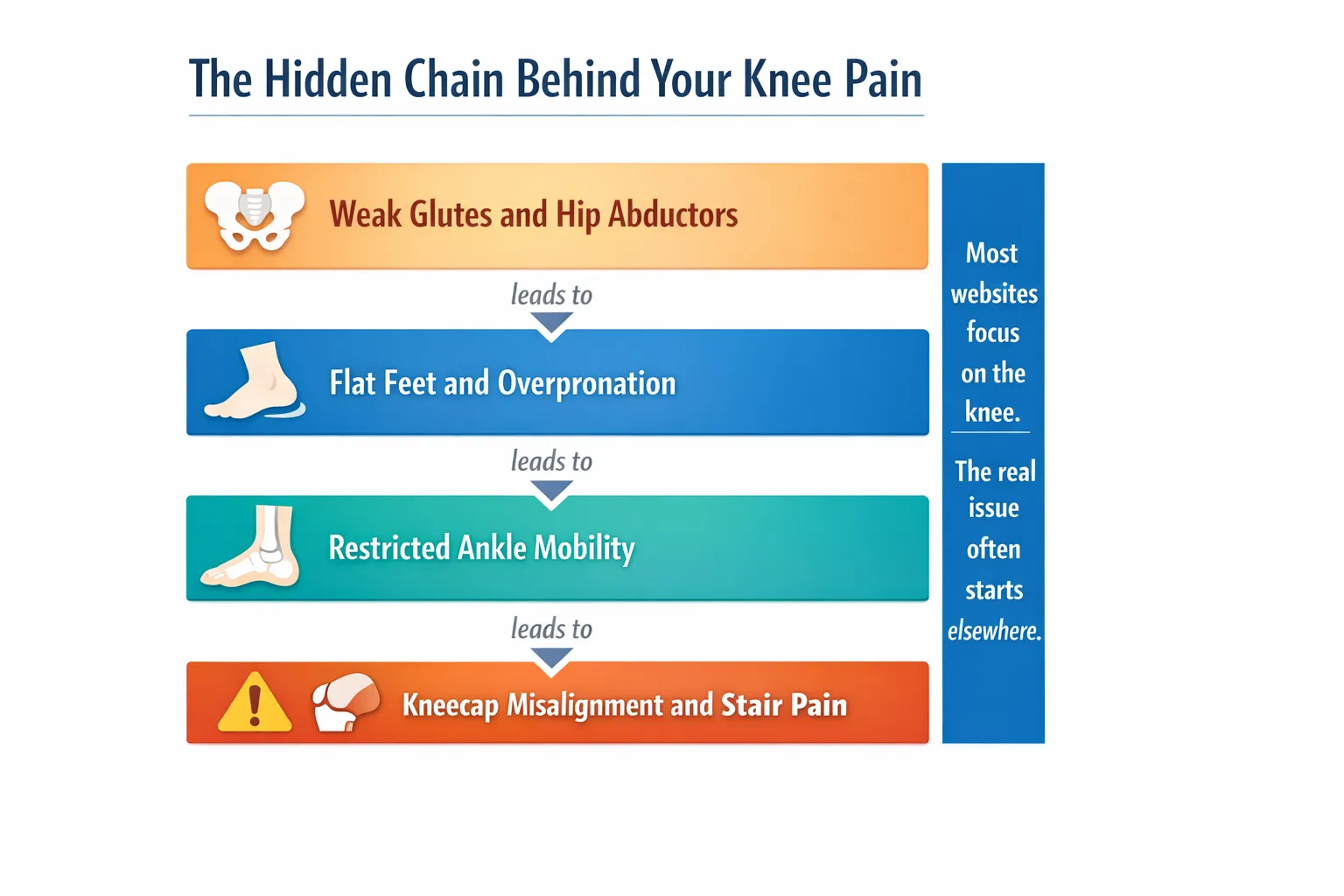
What most people don't realize is that knee pain on stairs very often starts several inches below the knee. Restricted ankle mobility (called limited dorsiflexion) forces the foot to compensate by rolling inward excessively, a pattern known as overpronation. This inward roll then causes the tibia to internally rotate, which in turn causes the femur to rotate and adduct, pushing the knee inward in a pattern called dynamic knee valgus or valgus collapse. Every step up the stairs with this pattern multiplies stress on the patellofemoral joint.
Research published in the Journal of Orthopaedic and Sports Physical Therapy and multiple biomechanical studies confirm this kinetic chain effect. An ankle problem becomes a knee problem, and the stairs make it visible.
The glutes, specifically the hip abductors, are supposed to stabilize the pelvis and control leg alignment during single-leg activities like stair climbing. When they are weak, the pelvis drops on the non-weight-bearing side. The body tries to compensate by leaning the trunk toward the stance leg. This compensation shifts forces at the knee into a valgus position, placing excessive strain on the medial ligaments and the ACL.
The reason this is important is that most people focus on the knee when the real weakness is in the hip. Strengthening your glutes, not just your quads, is one of the most effective ways to reduce stair pain caused by alignment issues. This is a detail that many generic online articles miss entirely.
People with flat feet or collapsed arches often have no foot pain at all. But their foot structure causes the tibia to internally rotate during weight-bearing activities. On stairs, where the knee must bend deeply under full body load, this internal rotation disrupts the normal tracking of the kneecap, increases patellofemoral joint stress, and over time accelerates cartilage breakdown. Simple shoe insoles or orthotics can make a significant difference in these cases.
A concerning trend in urban India, and particularly in cities like Hyderabad with large IT and corporate workforces, is the combination of long sitting hours with sudden physical demands. Sitting for extended periods tightens the hip flexors and hamstrings, reducing the flexibility that your knee needs to distribute load evenly when you suddenly climb stairs. A 2024 study on knee OA in rural South India found that sedentary lifestyle, obesity, diabetes, and hypertension were the most significant predictors of knee OA. And data from the national chronic pain prevalence study confirms that knee pain is the single most common location of chronic pain in India at 23.6%, ahead of back pain and head pain combined.
The direction of your stair pain is a useful diagnostic clue. Use this comparison to understand what your body might be signaling.
If going downstairs hurts significantly more than going up, the structural damage inside the joint may already be more advanced. This is worth discussing with an orthopedic specialist sooner rather than later.
A mild ache after unusual activity is one thing. But there are specific signs that mean your knee is asking for professional attention, not home remedies and hope.
• Sudden, sharp pain in the knee followed by inability to fully straighten or bend the leg
• Knee giving way or buckling while climbing the stairs
• Visible overnight swelling that was not there the day before
• A locking sensation where the knee gets stuck in a position mid-step
• Pain that wakes you from sleep, especially at night without any activity
• Both knees hurting simultaneously, which may indicate a systemic condition like rheumatoid arthritis
• Pain spreading to the hip or lower back, which suggests the compensatory movement patterns are already affecting other joints
• Stair pain that has lasted more than 3 to 4 weeks without improvement
• You are avoiding stairs, taking the elevator, or planning around the pain
• You can walk fine on flat ground but stairs stop you
• Morning stiffness that takes more than 30 minutes to ease after waking up
• Pain that changes sides, appears in a new location, or feels different from what it used to
A good orthopedic evaluation goes beyond asking where it hurts. Here is what a specialist will typically do to figure out the exact cause.
• Patellar Grind Test:Applies pressure to the kneecap to check for cartilage damage underneath
• McMurray's Test:A rotation test that checks for meniscus tears
• Thessaly Test:A weight-bearing rotation test, more accurate for meniscus evaluation
• Gait and Alignment Assessment:Checking how you walk, how your foot lands, and whether your knee caves inward
• X-ray:Shows bone structure, joint space narrowing (a sign of OA), and alignment. Fast and informative for most initial evaluations.
• MRI:The gold standard for soft tissue. Reveals cartilage quality, ligament condition, meniscus tears, and early bone changes not visible on X-ray.
• Ultrasound:Useful for detecting bursitis, tendon inflammation, and fluid in the joint.
Importantly, imaging alone does not tell the full story. A 2024 study from India found that many patients with significant radiological OA had manageable symptoms, while some with minimal X-ray findings had severe functional impairment. Clinical assessment and patient history matter just as much as the scan.
Treatment depends entirely on the cause, the severity, and how long the problem has been present. Here is a practical overview from least to most intensive.
The most important point in this table is the first row: most knee pain on stairs does not require surgery. Early intervention with the right physiotherapy and lifestyle changes can resolve or significantly reduce symptoms in the majority of cases.
1. Lead with the right leg.When going up stairs, step first with your stronger leg. When going down, step first with the weaker or more painful one. The phrase to remember is "good goes up, bad goes down." This reduces the eccentric load on the painful knee.
2. Use the railing.Shifting a small amount of your body weight through your arm on the railing can reduce the force on your knee by a meaningful amount. This is not a sign of weakness. It is smart biomechanics.
3. Strengthen your glutes daily.Lie on your side and do 15 to 20 clamshell repetitions each morning. Add glute bridges. These two exercises target the hip abductors and extensors that protect your knee alignment on every step.
4. Stretch your hip flexors and calves.Tight hip flexors and calves are two of the most underrated contributors to knee stair pain. A kneeling hip flexor stretch and a standing calf stretch against a wall, held for 30 seconds each, done twice daily, can noticeably reduce load on the knee within a few weeks.
5. Check your footwear.Worn-out soles that have lost their arch support are a major and overlooked cause of progressive knee valgus. If your shoes are more than a year old and you spend hours on your feet or stairs, it may be time to replace them or add orthotic insoles.
Shubham eventually stopped taking the elevator. Not because his pain disappeared overnight, but because he stopped ignoring what his body was telling him. An early MRI, a course of targeted physiotherapy, and one PRP session later, he takes the stairs every morning. He told us:"I just wish I had come in six months earlier."
Your stairs are not the enemy.They are just the messenger. The real question is: are you ready to listen to what your knee is trying to tell you? Because the earlier you do, the more choices you have.
Mild occasional discomfort after unusual activity can be normal. But persistent or worsening pain on stairs is not a normal part of aging and should be evaluated. Early-stage knee conditions are significantly more treatable than advanced ones.
In some mild cases involving muscle strain or minor inflammation, pain may resolve with rest and activity modification within a few days. However, if the cause is cartilage damage, meniscus injury, or osteoarthritis, the underlying condition will not heal on its own and is likely to worsen over time.
Going downstairs requires your knee to absorb more force (up to 346% of body weight vs. 316% for ascent) through an eccentric muscle contraction. This places more stress on the outer structures and the IT band in particular, which is why descent pain often signals a different or more advanced problem than ascent pain.
The most effective exercises target the quadriceps (especially the VMO), glute medius, and hip abductors. These include wall slides, clamshells, glute bridges, straight-leg raises, and step-downs. Calf and hip flexor stretching also reduces the mechanical load on the knee. A physiotherapist should guide you on the right exercises for your specific condition.
Surgery is considered when conservative treatments such as physiotherapy, medications, injections, and regenerative therapies have not provided adequate relief and the structural damage is confirmed to be severe (typically Grade 3 or 4 osteoarthritis). Most patients with early to moderate conditions can be managed without surgical intervention