Inauguration of the Latest CUVIS, the World’s Most Advanced Fully Active Robotic Joint Replacement System
by IT and Industries Minister Shri D. Sridhar Babu
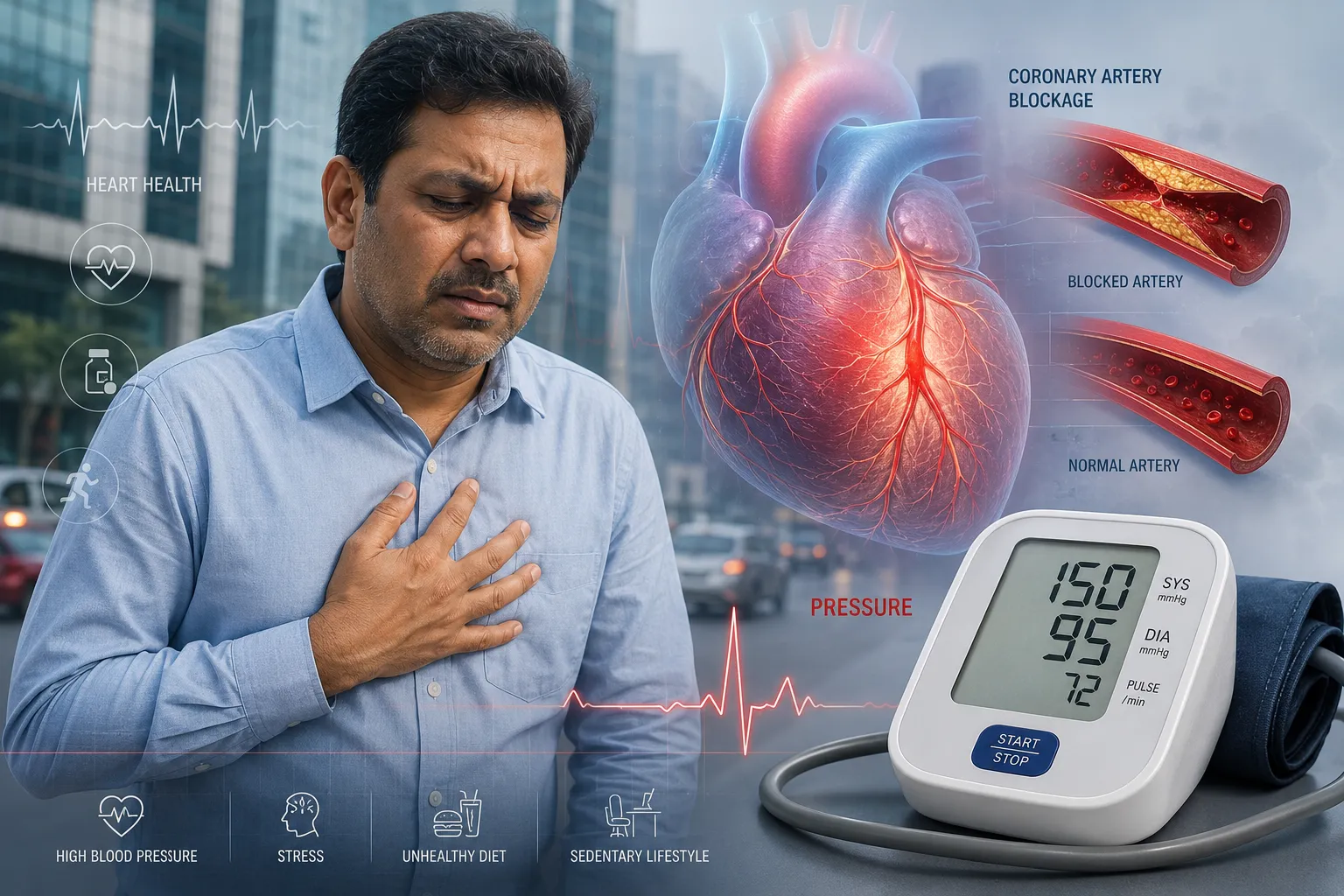
Coronary angioplasty, formally called percutaneous transluminal coronary angioplasty (PTCA) or percutaneous coronary intervention (PCI), is the most commonly performed procedure for treating blocked or narrowed coronary arteries. It restores blood flow to the heart muscle without open-heart surgery, typically through a small puncture at the wrist or groin.
At Germanten Hospital, our senior interventional cardiologist Dr. Mohammed Wasif Azam has performed over 10,000 complex coronary procedures. Our fully equipped flat-panel digital Cath Lab is available 24 hours a day for both emergency and elective angioplasty. Most patients are discharged within 24 to 48 hours and return to normal activity within a week.
The coronary arteries are the blood vessels that supply oxygen-rich blood to the heart muscle. In coronary artery disease, fatty plaques build up inside these arteries over years, gradually narrowing them and reducing blood flow. When a significant blockage is identified on coronary angiography, angioplasty is used to open the artery and restore normal circulation.
The procedure involves guiding a thin, flexible catheter to the blocked artery under X-ray imaging. A small balloon at the tip of the catheter is inflated to compress the plaque and widen the artery. In virtually all cases today, a stent (a small metal mesh tube) is then placed at the site to hold the artery open long-term. Modern drug-eluting stents release medication that prevents scar tissue from forming inside the stent, significantly reducing the risk of the artery re-narrowing.
Emergency angioplasty (primary PCI) is the definitive treatment for a complete coronary blockage causing a STEMI. Speed is critical. Our golden-hour protocol targets Cath Lab access within 60 minutes of hospital arrival.
Significant blockages causing rest pain or enzyme-positive events are treated urgently with angioplasty within 24 to 72 hours of presentation.
Patients with chest pain on exertion and significant blockages confirmed on angiography who do not respond adequately to medications are candidates for elective angioplasty.
A stress test showing significant ischemia (reduced blood flow) during exercise, even without symptoms, may prompt angiography and angioplasty if a significant blockage is found.
Blockages in old bypass grafts can be treated with angioplasty and stenting in appropriate cases.
Angioplasty may not be the preferred option in all cases. Patients with complex three-vessel disease, left main artery disease, or diabetes often achieve better long-term outcomes with coronary bypass surgery (CABG). Our team will discuss both options with you based on your angiography findings.
Blood tests, ECG, and a review of medications are completed before the procedure. Antiplatelet medications (aspirin and clopidogrel) are started beforehand to prevent clot formation during and after the procedure.
A local anesthetic is applied to the wrist (radial approach, preferred) or groin (femoral approach). A small sheath is inserted into the artery through which all catheters pass.
A guide catheter is advanced to the opening of the coronary artery under X-ray guidance. Contrast dye is injected to visualize the arteries and identify the blockage precisely.
A thin guidewire is carefully passed through the blockage, providing a track over which the balloon catheter travels.
The balloon is positioned at the blockage and inflated for 20 to 30 seconds, compressing the plaque against the artery wall and widening the channel.
A drug-eluting stent mounted on the balloon is deployed at the site. When the balloon is inflated, the stent expands and locks into place, acting as a permanent scaffold to keep the artery open.
Contrast dye is injected again to confirm the artery is fully open and blood flow is restored. The catheters are removed and the wrist or groin access site is closed.
The patient is transferred to the cardiology ward or cardiac ICU for monitoring. Wrist-access patients typically sit up within a few hours. Most are discharged the following day.
The entire procedure typically takes 45 to 90 minutes for a single-vessel case. Complex multi-vessel procedures may take longer. You are awake throughout with sedation available if needed.
At Germanten, we strongly prefer the transradial (wrist) approach for most angioplasty procedures. The evidence for radial access is compelling:
The current gold standard. A metal stent coated with medication (typically everolimus or zotarolimus) that is slowly released to prevent scar tissue from forming inside the stent. Reduces restenosis rates to under 5%.
A newer type of stent made from a material that dissolves over 2 to 3 years, leaving no permanent metal in the artery. Suitable for selected younger patients and specific anatomical situations.
Older generation stents without drug coating. Higher restenosis rate than DES. Used in specific situations where long-term dual antiplatelet therapy is contraindicated (such as upcoming surgery).
Not all coronary blockages are straightforward. Our Cath Lab is equipped and our team is trained to handle complex interventions that many centers refer elsewhere.
24 to 48 hours for elective cases. Emergency cases (primary PCI) typically 3 to 5 days.
Most patients within 5 to 7 days.
3 to 5 days after radial-access procedures (wrist). 1 to 2 weeks after femoral access.
Walking encouraged from day 1 after discharge.
Recommended for all post-angioplasty patients. Improves long-term outcomes significantly.
Dual antiplatelet therapy (aspirin plus clopidogrel or ticagrelor) for 6 to 12 months minimum after DES implantation. Statin, beta-blocker, and ACE inhibitor as appropriate.
Cardiology review at 1 month, 6 months, and 12 months post-procedure as standard.
All post-angioplasty patients at Germanten are enrolled in our cardiac rehabilitation programme which significantly reduces the risk of recurrent events.
Coronary angioplasty is a well-established, low-risk procedure when performed by experienced operators in an equipped facility. Overall complication rates at high-volume centers are well below 1% for elective cases. Specific risks include:
Emergency angioplasty for heart attack carries higher risk than elective procedures, reflecting the severity of the underlying condition rather than the procedure itself. Our team discusses individual risk in detail with every patient before proceeding.
Consult expert cardiologists in Hyderabad at Germanten Hospital

I visited Germanten Hospital for chest pain. The cardiologist explained my heart condition clearly, reviewed my ECG, and guided me with the right treatment plan. The staff was incredibly helpful.
Germanten is a trusted hospital for heart care. My tests went smoothly, and the doctor explained the reports in simple language. I felt completely comfortable throughout the visit.
I consulted their heart specialist for high blood pressure. The doctor listened patiently and gave practical advice for managing my heart health. Excellent patient care.
My father needed guidance for a heart angiography. The cardiology team here is fantastic—they are some of the best doctors we have met. They explained every step of the procedure clearly.
I had a great experience with the cardiology department. From booking the appointment to the consultation, everything was managed perfectly. The doctor gave honest and clear advice
I went to Germanten for a preventive heart check-up. The specialist evaluated my risk factors and suggested simple, effective lifestyle changes. It was a very reassuring visit.


Watch our cardiologists explain common heart symptoms, risk factors, diagnostic tests and preventive measures.

Expert advice on maintaining cardiovascular health

Preventive measures for cardiac conditions

Understanding common heart warning signs

Overview of cardiac diagnostic procedures

Key risk factors for cardiovascular disease

Modern treatment approaches for heart conditions
by IT and Industries Minister Shri D. Sridhar Babu
by Health Minister Shri Damodar Rajanarsimha
 01 / 12
Connect with our experts doctors for guidance
Find the best cardiologist in Hyderabad. Know what to look for, red flags to avoid, and 15 must-ask questions before your first cardiac specialist visit
Read MoreLearn how a cardiologist supports better heart health through diagnosis, prevention, regular check-ups, lifestyle guidance and cardiac care in Hyderabad
Read MoreLooking for the best cardiologist in Attapur Hyderabad? Learn what to look for, key credentials to check, and why Dr Mohammed Wasif Azam Germanten at Germanten Hospital is a trusted choice for heart care
Read MoreUnderstand how high blood pressure silently damages your heart. A Hyderabad cardiologist explains the link between hypertension and heart disease, risk factors, and treatment options for patients in Attapur and across Hyderabad.
Read MoreDiscover the 10 most common heart disease risk factors in Hyderabad and how to reduce them. Expert advice from a preventive cardiologist in Attapur on diet, lifestyle, and cardiovascular prevention.
Read MoreExperiencing chest tightness or desk fatigue? Learn the 10 critical heart problem symptoms corporate workers in Hyderabad ignore. Book a checkup today.
Read MoreSpot the early signs of heart disease early, from chest pain to silent symptoms. Get expert cardiology care at Germanten Hospitals, Attapur, Hyderabad.
Read MoreGermanten Hospital is located in Attapur, one of South Hyderabad's most accessible neighborhoods. Patients from across southern and western Hyderabad can reach us within 20 to 30 minutes.